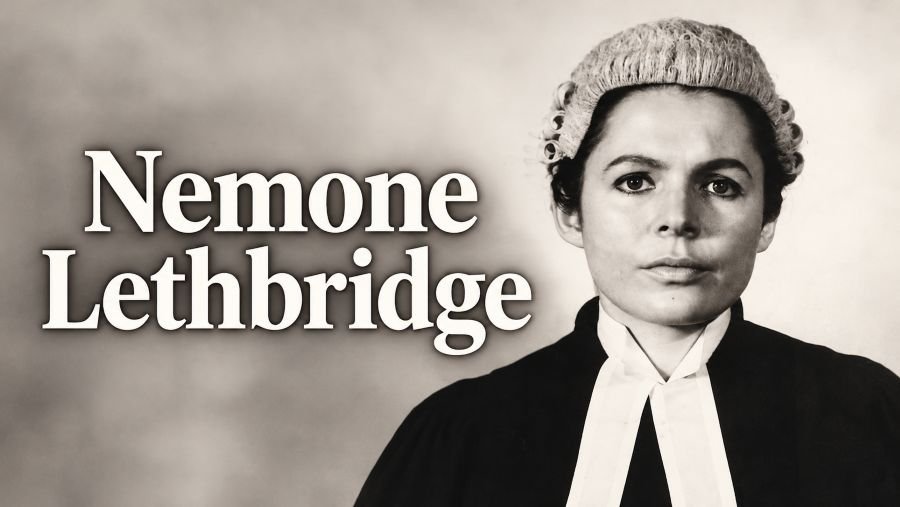
Nemone Lethbridge: The Barrister Who Refused to Give Up
Introduction
Nemone Lethbridge is a British barrister and playwright who entered the legal profession at a time when women still faced open discrimination at the Bar.
She was called to the Bar at Gray’s Inn in 1956. Her early work focused on criminal law, and she later became known for representing the Kray twins. Her legal career was interrupted after her marriage to Jimmy O’Connor became public, but she did not disappear from professional life. She wrote television plays, returned to the Bar in 1981, and later gave free legal advice through a community law centre.
Her story has another chapter, too. At 93, she was still publicly campaigning in 2025 to challenge O’Connor’s murder conviction, which he had always maintained was wrongful.
Quick Facts
| Detail | Information |
|---|---|
| Full Name | Nemone Lethbridge |
| Born | 1932 |
| Profession | Barrister and playwright |
| Education | Somerville College, Oxford |
| Field of Study | Law |
| Called to the Bar | 1956 |
| Inn of Court | Gray’s Inn |
| Main Legal Field | Criminal law |
| Known For | Legal career, television writing, work for the Kray twins |
| Former Husband | Jimmy O’Connor |
| Later Legal Work | Community and pro bono legal advice |
| Major TV Work | Baby Blues |
| Current Public Focus | Campaign concerning Jimmy O’Connor’s murder conviction |
Early Life and Education
Nemone Lethbridge was born in 1932.
Her route into law began at Oxford. She studied law at Somerville College, starting at a time when women were still a small minority in legal education.
In 1952, she was one of only two women reading law at Somerville. She later recalled dismissive attitudes toward female law students, including the assumption that women would marry rather than build serious legal careers.
She kept going.
That choice mattered.
Lethbridge entered a profession where legal ability was only part of the battle. Being a woman could affect access to chambers, facilities, briefs, and even everyday treatment from colleagues.
Nemone Lethbridge’s Legal Career
Lethbridge was called to the Bar at Gray’s Inn in 1956.
She moved toward criminal law and became the only female tenant at her chambers. Getting work was tough. First 100 Years reports that clerks were reluctant to give her briefs, so she found work herself.
Her client list eventually included the Kray twins, Ronnie and Reggie Kray, whose names later became closely linked with organised crime in London’s East End.
This came early in her career.
She was still a young barrister.
Yet discrimination remained part of daily professional life. During a First 100 Years discussion, Lethbridge recalled being denied access to the lavatory used by male barristers in chambers. She instead had to use facilities at a nearby café.
Small detail?
Hardly.
It gives a clear picture of what women entering the Bar faced at the time.
Marriage to Jimmy O’Connor
Lethbridge’s personal life soon collided with her legal career.
She became involved with Jimmy O’Connor, who had been convicted of murder years earlier.
Their marriage became public while Lethbridge was building her career. First 100 Years reports that her tenancy in chambers was terminated after news of the marriage came out.
That changed everything.
She spent roughly 18 years away from regular practice at the Bar.
But she kept working.
She moved into writing and found another outlet for subjects involving law, society, women, family life, and difficult personal experiences.
A New Career in Television Writing
Lethbridge became a television playwright during her years away from legal practice.
One of her best-known pieces was Baby Blues, broadcast by the BBC in December 1973 as part of Play for Today.
The play dealt with maternal mental illness, childbirth, depression, family strain, and the lack of support experienced by some women after giving birth.
These were not easy subjects for mainstream television at the time.
Academic research published in Women’s History Review describes Baby Blues as an autofictional work and links it with changing public discussion around postnatal depression and psychosis in 1970s Britain.
The programme drew strong reactions.
It also had consequences beyond television.
Research on the play says Lethbridge set up Depressives Anonymous in 1974, a grassroots support initiative connected with issues raised by the broadcast.
So her writing was not separate from public life.
It fed back into it.
Returning to the Bar
Lethbridge eventually returned to legal practice in 1981.
First 100 Years records that she practised again from 1981 until 2007.
That return came after nearly two decades spent largely outside her original profession.
For many people, that would have been the end of the legal story.
Not for her.
She rebuilt her place at the Bar and later turned much of her attention toward people who had limited access to legal help.
Community Legal Work
Another major part of Lethbridge’s later career was community law.
She helped establish a law centre in Stoke Newington, where legal help was offered to people dealing with serious day-to-day problems.
First 100 Years reported that she worked there regularly, with much of her caseload involving immigration matters.
Her professional work continued well beyond the age when most lawyers retire.
That point is striking.
She did not simply maintain an association with law. She kept working with clients.
Reports surrounding her later public appearances said she was still carrying out pro bono legal work in her nineties.
The Long Fight Over Jimmy O’Connor’s Conviction
Jimmy O’Connor had been convicted of murdering George “Donk” Ambridge in 1942.
He maintained his innocence.
Lethbridge came to share that belief and spent decades seeking to challenge the conviction.
The case remained important to her long after O’Connor’s death in 2001.
In September 2025, The Observer interviewed Lethbridge at the age of 93 and reported that she was still working with her sons, Ragnar and Milo O’Connor, in an effort to clear their father’s name.
The wording needs care here.
O’Connor’s innocence has not been established by a court in the material reviewed for this article.
Lethbridge and her family argue that his conviction was wrongful. That remains their position and the basis of their continuing campaign.
Nemone Lethbridge and Baby Blues
Baby Blues deserves special attention because it links several parts of Lethbridge’s public life.
Law.
Writing.
Women’s experiences.
And social attitudes.
The 1973 production addressed subjects that many families rarely discussed openly. Academic researchers later examined the play’s treatment of maternal mental illness and its place within wider changes in public discussion during the 1970s.
That gives Lethbridge’s television career historical weight beyond entertainment alone.
Her work became source material for later academic study.
Sexism at the Bar
Looking back, Lethbridge’s experiences also show how different the legal profession was for women entering it in the 1950s.
She dealt with barriers that had nothing to do with courtroom skill.
Access to work could be harder.
Chambers culture could be openly hostile.
Even ordinary facilities were treated differently for women.
Yet she found cases herself and built a criminal practice anyway.
Basically, she had to prove her right to be there while doing the job itself.
Her experiences are now featured by the First 100 Years project, which records the history of women in law following the Sex Disqualification (Removal) Act 1919.
Why Is Nemone Lethbridge Known?
Nemone Lethbridge is mainly known for her long connection with British law and television.
Her public story includes:
- entering the Bar during the 1950s;
- practising criminal law;
- representing the Kray twins;
- facing discrimination as a female barrister;
- losing her chambers position after her marriage became known;
- becoming a television playwright;
- writing Baby Blues;
- returning to legal practice in 1981;
- carrying out community and pro bono legal work;
- campaigning over Jimmy O’Connor’s murder conviction.
Few careers follow such a straight line.
Hers certainly did not.
Nemone Lethbridge’s Books and Writing
Lethbridge’s writing was not limited to television.
She later published work about her own experiences, including Nemone, which recounts parts of her legal career, the barriers women faced in the profession, and her relationship with Jimmy O’Connor.
She has also been associated with poetry writing.
Still, television remains an important part of her public record because programmes such as Baby Blues dealt directly with difficult social issues.
Her Place in British Legal History
Lethbridge’s importance comes partly from timing.
She entered the Bar in the mid-1950s, only a few decades after women were formally allowed to enter the legal profession.
Then she stayed connected to law across many decades.
Her career was interrupted.
It changed direction.
Then it restarted.
That makes her story useful for understanding both the progress women made in British law and the resistance they met along the way.
Her work also crossed professional borders.
Barrister. Writer. Community adviser.
Different jobs, same interest in people facing hard situations.
Current Status
As of the latest substantial reporting reviewed for this article, Nemone Lethbridge was 93 years old in September 2025.
At that time, she remained publicly focused on the attempt to challenge Jimmy O’Connor’s conviction.
Given that she was born in 1932 but a precise birth date was not confirmed by the strongest sources reviewed, this article does not calculate or present a new age for 2026.
That keeps the information accurate.
Final Thought
Nemone Lethbridge’s career did not follow an easy path.
She entered criminal law when women faced open barriers. She lost her chambers position, moved into television writing, and eventually returned to the Bar.
Then she kept helping people.
Decades later, her work still appears in legal history projects, academic research, and public discussions about justice.
Her story is really about persistence.
Simple as that.
Frequently Asked Questions
Who is Nemone Lethbridge?
Nemone Lethbridge is a British barrister and playwright. She became known for her work in criminal law, her television writing, and her long career supporting people through legal work.
When was Nemone Lethbridge born?
Reliable sources confirm that she was born in 1932. A precise birth date has not been included because it was not confirmed by the strongest sources used for this article.
Where did Nemone Lethbridge study?
She studied law at Somerville College, Oxford.
When was Nemone Lethbridge called to the Bar?
She was called to the Bar at Gray’s Inn in 1956.
Did Nemone Lethbridge represent the Kray twins?
Yes. First 100 Years records that she became a lawyer used by the Krays during her early criminal-law career.
Who was Nemone Lethbridge’s husband?
She married Jimmy O’Connor, who had previously been convicted of murder and maintained his innocence.
What happened to Nemone Lethbridge’s legal career after her marriage?
Her chambers tenancy ended after her marriage to O’Connor became publicly known. She later worked as a television writer before returning to the Bar in 1981.
What is Baby Blues?
Baby Blues was Lethbridge’s television play broadcast by the BBC in 1973. It dealt with maternal mental illness and later became the subject of academic research.
Is Nemone Lethbridge still alive?
The latest authoritative reporting used for this article interviewed her in September 2025, when she was 93.
What is Nemone Lethbridge’s net worth?
This article does not provide a net-worth figure because no reliable financial source reviewed supports one.